Image

Avon River - Avon Pelham Brook

Basin : Avon River

Catchment : Avon River

River condition of the Avon Pelham Brook site (site code: SA1AVON1, site reference: 6154195) on the Avon River at Toodyay, was assessed between 13 and 14 November 2023. Results were compared with previous assessments.

Healthy Rivers assessments are conducted using standard methods from the South West Index of River Condition (SWIRC), which incorporates field and desktop data from the site and from the broader catchment. Field data collected include the following indicators, assessed over about a 100 m length of stream:

  • Aquatic biota: fish and crayfish community information (abundance of native and exotic species across size classes, general reproductive and physical condition)
  • Water quality: dissolved oxygen, temperature, specific conductivity, and pH (logged in situ over 24 hours) as well as laboratory samples for colour, alkalinity, turbidity and nutrients
  • Aquatic habitat: e.g. water depth, substrate type, presence of woody debris and detritus, type and cover of macrophytes and draping vegetation
  • Physical form: channel morphology, bank slope and shape, bioconnectivity (barriers to migration of aquatic species), erosion and sedimentation
  • Fringing zone: width and length of vegetation cover within the river corridor and lands immediately adjacent, structural intactness of riparian and streamside vegetation
  • Hydrology: measures of flow (velocity) at representative locations (compared against data from stream gauging stations within the system)
  • Local land use: descriptions of local land use types and activities (compared against land use mapping information for the catchment)

The site was previously assessed during November 2019.

This site was one of four assessed on the Avon and Dale rivers during November 2023; the other sites were Avon York, Gwambygine Pool and Reserve Pool.

Other departmental data: The Avon Pelham Brook site is about 400 m upstream of the Department of Water and Environmental Regulation’s (the department) flow gauging station on the Avon River known as Stirling Terrace Toodyay (site reference: 615026), which has been in operation since 1996.

Search the site code or site reference in the department's Water Information Reporting (WIR) system to find data for this site and nearby sampling points (flows, surface water quality, groundwater monitoring, the department's meteorological data)See also the Bureau of Meteorology website for additional meteorological data for the area.

Condition summary

The image below indicates the conditions at the Avon Pelham Brook site in November 2023. November is within the Noongar season of Kambarang (second spring), which is traditionally seen as a transformational time of year with many plants flowering. The season is marked by longer periods of dry weather and rising temperatures. Further images are provided in the gallery at the bottom of the page to show general site conditions and features.

A summary of site condition over the latest monitoring period is provided in the sections below. For other site data, please contact the department’s River Science team (please reference the site code and sampling dates).

River setting

The Swan-Avon catchment is the largest catchment in south-west Western Australia, covering over 120,000 km2. It is climatically and geologically diverse. The mainstem of the Avon River has its headwaters at Lake Yealering, 40 km east of Pingelly. It travels northwards, joins the Dale River and passes through Beverley, York, Northam and Toodyay before turning east and then south-east as the river traverses the Darling Scarp before it joins Wooroloo Brook, where the Avon River becomes the Swan River.

The Avon Pelham Brook site is on the Avon River in the Wheatbelt town of Toodyay, about 85 km north-east of Perth. Prior to European settlement, the Avon River in Noongar Ballardong country was a braided river, with many small channels amongst vegetated islands and with deep, well-shaded pools.

Historically, the Avon River has been disturbed by two activities: clearance of woodland for agriculture, and ‘training’ of the river channel to abate flooding. These two activities mobilised the salt that was long established deep in the soil, and the coarse riverbed sediments, respectively.

The cumulative effects of land clearing, eutrophication, salinisation, sedimentation and the river training scheme resulted in a highly degraded catchment and river system. However, as awareness has increased over recent decades, significant investment and progress has been made to fence, revegetate and protect the Avon River channel. It is estimated at least 95 per cent of the Avon River has been fenced and that significant recovery of riparian vegetation has occurred as a result (NRM Wheatbelt 2013). However, fencing needs constant maintenance, and the current condition of the fencing is unknown.

The Avon Pelham Brook site is in a meandering plane-bed channel within a moderately broad river valley as the Avon begins to pass through the Darling Range. This is characteristic of the Wheatbelt, in the zone of rejuvenated drainage of the Avon River. The site was classed as a channel, with shallow riffles upstream and downstream of the site, making it a shallow pool that will disconnect from the wider system over summer.

At the time of sampling, water depth varied, with an average depth of 0.5–0.99 m, and maximum depth of 1.5–2.0. Channel width was an average of 50 m and the bankfull width was about 130 m. The river is within a low-gradient section but had vertical to steep, concaved banks. The channel was mostly U-shaped, but with some stepped and box shaped sections.

Aquatic habitat

Aquatic habitat was classed as suboptimal, because of high sediment deposition, limited stream shading, limited woody debris, and reduced water quality (dissolved oxygen, nutrients, salinity). This is consistent with the 2019 assessment observations.

The dominant feature of the site was the widespread deposits of sandy sediment, which produced a large, anoxic-smelling plume when disturbed. This was likely because of the decomposition of biological material (leaves, algae, detritus and epiphytes) which was moderately dense on the substrate throughout most of the site. Woody debris was only sparsely distributed through the site. Smaller (less than 10 cm diameter) wood was observed than would be expected in natural, undisturbed systems.

Limited stream shading is a legacy of the river training scheme of the 1950’s and 1970’s. Prior to European settlement the Avon was a braided river with vegetated islands providing shade across the active channel width. Following widening and deepening of the river channel to reduce flooding risk, the river has become one broad channel with shading only provided from the banks, leaving most of the wetted width unshaded.

Submerged macrophytes (Charophytes) covered 75 per cent of the site and the seagrass (Ruppia spp. – see image below) was also observed. This extensive submerged macrophyte cover would provide habitat and shelter for small and juvenile fish.

As well as suboptimal dissolved oxygen and elevated nutrients (which is discussed in the water quality section), the site was also affected by salinity (characteristic of much of the Avon River). The elevated salinity has impacted the aquatic macrophytes and riparian vegetation species found at the site. As a result, the habitat has been substantially modified with salt tolerant species recorded, e.g. swamp sheoak (Casuarina obesa) and samphire.

Flow & connectivity

The surface hydrology of the Avon River is highly variable. Between 1997 and 2023 the department’s gauging station at Stirling Terrace (GS# 615026), which is immediately downstream of the assessment site, has recorded an average annual discharge of 118 gigalitres (GL), but with a standard deviation of 115 GL. Annually, the flow cycle has three main phases, typical of many river systems in the south-west of Western Australia (Wheatbelt NRM 2013):

  • bank flow – medium to high flows with occasional inundation of the floodplain
  • wet connected – connected pools allow biota to recolonise the broader aquatic habitat from the refuge pools
  • wet isolated – pools provide refuge habitat but are disconnected.

The period of disconnection during the wet isolated phase, over the dry and hot summer months, is likely to increase across the south-west of Western Australia in response to a drying climate.

The geomorphology and hydrogeology of the Avon River is complex and highly compartmentalised, with many localised aquifers and strong interaction between groundwater and surface water. It appears that water quality in the Avon River pools is locally influenced by these interactions, with horizontal seeping and vertical upwelling of either fresh and/or saline waters, particularly during summer months (Wheatbelt NRM 2013).

Based on records from DWER gauging stations along the Avon (at Toodyay, Northam and York) the Avon River dries to pools (wet disconnected flow phase) from late spring to early summer through to autumn. During this period, the pools are a critical refuge for aquatic fauna but are often under the greatest stress from water quality issues revolving around saline groundwater intrusions and increased incidence of potentially harmful algal blooms (e.g. cyanobacteria) due to eutrophication. The additional impact of sedimentation and filling of these pool refuges increases the threat to the ecological health of the system.

At the time of sampling the site was connected upstream and downstream through two shallow riffles, although flow was minimal. The image below shows the upstream riffle. Records from the department’s gauging station (station number 615026) at the bottom of the site indicate that flow had ceased 10 days prior to sampling. While this wasn’t quite the case at the time of sampling flow was below the capacity for the flow gauging equipment to detect. Evidence from historical sampling programs demonstrate that habitat disconnection (isolation of pools) occurs soon after flow is ‘below detect’ at the gauge. At this site, it is known from other sampling programs that through summer, as the water level drops, the site disconnects from the wider system both upstream and downstream but maintains water year-round.


Vegetation

The riparian zone (containing species adapted to living at the interface between aquatic and terrestrial environments) was 75 m wide on the left bank, and 30 m on the right bank, which was largely because of the shape and gradient of the land next to the river channel. The vegetation at the site consisted of a native tree canopy with an exotic understory which is typical of remnant vegetation in a disturbed or modified system. The vegetation at the site was broadly similar to what was observed during the previous river health assessment in November 2019.

The tree layer was quite distinct between the two banks. Mature flooded gums (Eucalyptus rudis) dominated the left bank and were close to the riverbank, which provided some shading along the margins of the pool. On the right bank, sheoak (Casuarina spp.) was the dominant tree species. The sheoak is a smaller tree and were set back from the riverbank, so provided less shading to the river than the flooded gums on the left bank. The image below illustrates the difference in the tree layer but please note the photograph was taken looking upstream, so the banks are reversed (under the SWIRC method banks are named ‘left’ and ‘right’ while facing downstream).

While the tree layer was present, both the shrub and ground cover vegetation were reduced. The shrub layer was almost entirely absent with just a few teatree (Melaleuca spp.) observed on the left bank, and none on the right. While the ground layer was dominated by exotic grasses, some native species were present including saltbush, sea heath, atriplex and samphire. All these species are salt tolerant, illustrating the salinised nature of the river. The image below shows samphire growing in the sandy margins of the pool.

Natural and planted recruitment of native woody vegetation (trees and shrubs) was observed at the site, in a healthy condition and of moderate extent through the site. The Toodyay Friends of the River community group has been undertaking rehabilitation works on the Pelham Brook watercourse to reduce erosion from peak flow, with work restoring the riparian zone between the river and the townsite on the right bank. This area includes the extent of bankfull flow (when the river floods beyond the channel). The riparian corridor at Avon Pelham Brook HRP site is also managed by the Department of Fire and Emergency Services (DFES) as the river corridor is in a fire risk zone. This highlights the complexity of river management, with often competing priorities between environmental health and protecting public safety, particularly around urban areas.

The banks were assessed as having excellent structural integrity with only minimal erosion evident at the site, although human access (vehicle tracks) and cleared vegetation may increase the risk of erosion. Evidence of catchment wide erosion and mobilisation of sediments within the river channel (as a legacy of the river training scheme) was observed through the widespread sedimentation that was observed at the site. As noted in the aquatic habit section, the dominant feature of the site was the widespread deposits of sandy sediment, which contained high levels of decomposed organic material that resulted in large, anoxic-smelling plumes when disturbed.

Water quality

Below is a graph of the water quality recorded during the 24-hour assessment.

Water quality was generally suboptimal based on dissolved oxygen, salinity and nutrient concentrations.

Water temperature was optimal and didn’t exceed the 25°C threshold1 during the 24-hour assessment period. It is important to note that the assessment was carried out in early spring, and it is likely that during the warmer summer months the water temperature will exceed the maximum tolerance threshold routinely, especially considering the lack of shading for most of the channel width.

Dissolved oxygen concentrations were suboptimal and fell below the 4mg/L2 threshold for 9 consecutive hours between midnight and 9 AM. The diurnal range was also suboptimal with a range of 10.25 mg/L over the 24-hour period, which is more than double the 4 mg/L daily range that would be expected under optimal conditions.  This pattern of dissolved oxygen concentrations over the 24 hours indicates biological drivers are influencing dissolved oxygen, e.g. algae producing oxygen during the day (photosynthesis) and consuming oxygen during the night (respiration). This is supported by field observations that included 75 per cent charophyte cover across the substrate, and 10 per cent cover of filamentous algae (both floating and benthic mats), as well as algae observed in the water column and on the substrate (including any woody debris and macrophytes). Considering that the assessment was conducted in early spring it is likely that the suboptimal dissolved oxygen conditions will continue, and likely worsen, placing greater stress on aquatic fauna through the warmer summer months. Increased photoperiod and heat will likely drive greater algal activity which will also increase the diurnal range in dissolved oxygen and periods of very low dissolved oxygen may occur overnight. A similar pattern of dissolved oxygen concentrations (suboptimal daily flux and below 4 mg/L overnight) was also recorded at this site in 2019.

Specific conductivity (which can be used as an indicator of salinity) was an average of 17.25 mS/cm over the 24-hour assessment period, which is in the mid-saline range. This is more saline than the upstream York HRP site (which was an average of 15.67 mS/cm). This demonstrates the Avon River becoming more saline moving downstream from the Dale River (upstream of Gwambygine Pool), which provides a localised freshening effect. A similar pattern of increasing salinity moving downstream on the Avon River was also observed during the November 2019 assessments.

pH was optimal (average of 7.97), based on expectations of natural ranges for freshwater rivers of south-west Western Australia. Turbidity was 12 nephelometric turbidity units (NTU), which is high. True colour was 70 true colour units (TCU), this was consistent with the field observations for tanning staining of “slight”.

Nutrient concentrations were both suboptimal, indicating eutrophic conditions. Total nitrogen was 2.20 mg/L (very high), and total phosphorus was 0.199 mg/L (high, and on the cusp of very high [>0.2 mg/L]). This is a noticeable increase from the York site where total nitrogen was 1.16 mg/L and total phosphorus was 0.067 mg/L. This suggests the subcatchments between the 2 sites are contributing N and P and this is likely, at least in part, from the Mortlock North and East subcatchments which have a history of high nutrient loads as well as high salinity. A similar pattern of increasing nutrient concentrations was observed in November 2019; while the absolute values were slightly lower, there were increasing concentrations of nitrogen and phosphorus moving downstream.

Footnote:

1 An upper limit for temperature is nominally set at 25°C based on the range recorded in sites where south-west native fish species are typically found to occur (Beatty et al. 2013).

2 A lower limit of 4 mg/L is taken from the SWIRC where it is used as a guideline limit for condition scoring. This level aligns with Beatty et al. (2013) where south-west native fish species were shown to typically reside in sites with levels above 4 mg/L.

Species found in subcatchment

This includes all species found within the subcatchment of the assessment site, from this and previous studies in the area. The photos are linked to more information about each species, including maps of where they are expected across the south-west.

Species found at the site

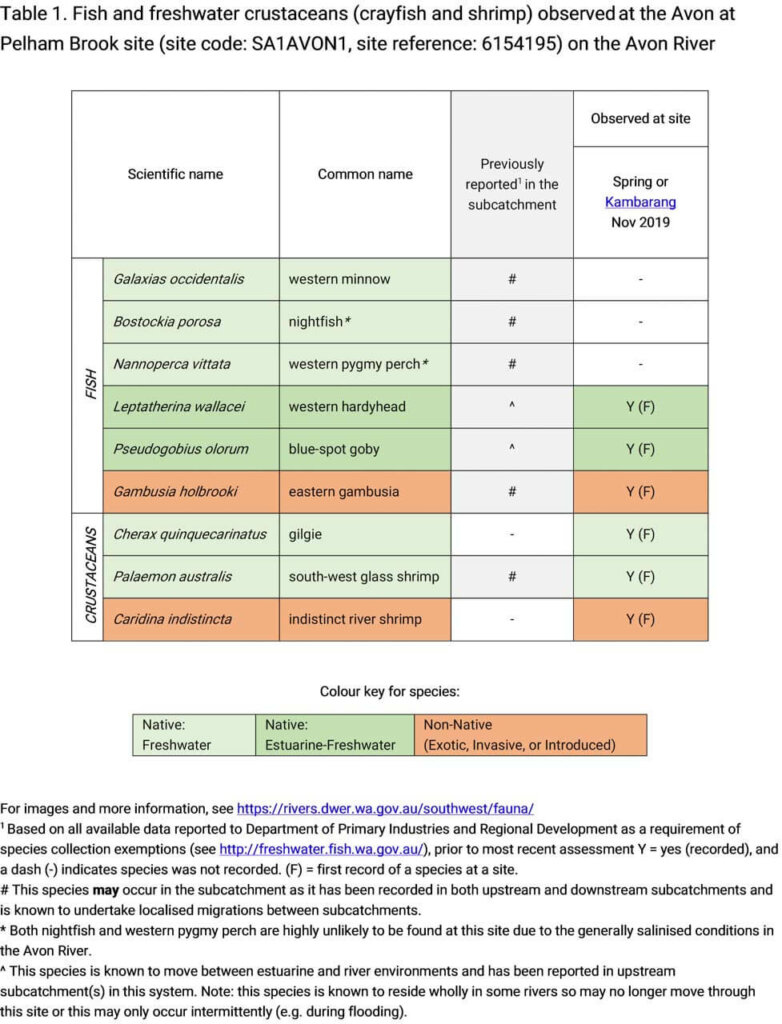
Fish and crayfish

The species expected to occur here are based on species found at the site and elsewhere within the wider subcatchment. As differences in habitat within a reach naturally influence species distributions, and variability in methods between sampling programs can affect the species caught, this list is only indicative.


Three species of fish and three crustacean species were recorded during the 2023 sampling. This included two native and one exotic fish species, and two native and one exotic crustacean species. This was consistent with observations recorded during the previous assessment in November 2019.

The native fish population was entirely made up of the two estuarine opportunistic species, blue-spot goby and western hardyhead, as was the case in November 2019. While these species usually reside in estuaries and move upstream into rivers as conditions suit, they have become established inland in the salinised Avon system. Both species were relatively abundant, and juveniles were observed, suggesting the populations are well established and recruiting.

The exotic eastern gambusia was the most abundant fish at this site and juveniles were also recorded, as was the case in 2019. Invasive species, like gambusia, often outcompete native species, particularly in suboptimal conditions as were observed at this site at the time of sampling.

Two native crustacean species were also recorded, the gilgie and the south-west glass shrimp. The presence of gilgies was surprising because the site’s salinity exceeded their documented salinity tolerances. The species was also detected in 2019; this may indicate a freshwater seep somewhere in the pool, supporting the presence of this freshwater species, and the Avon is known for its complex and highly variable hydrogeology. The south-west glass shrimp was abundant and with an estimated 9,000 individuals recorded, this species accounted for more than 90 per cent of the total catch at the site. This does not reflect a balanced food web however, the dominance of a lower trophic level species (a primary consumer in this case) indicates a eutrophic (nutrient enriched) system.

The exotic crayfish species yabby was recorded at this site for the first time in 2024. The detection of this species is a direct risk to the small and likely vulnerable population of gilgies at the site. Yabby will tend to outcompete and be more aggressive than the native gilgie. The presence and relative abundance of both species will be closely monitored over future assessments.

Two freshwater species, nightfish and western pygmy perch, are listed (using spatial distribution software) in the fish table, having been recorded upstream and downstream of a site and so may be present at this site, but they were not observed. Upstream detections were in the Dale River, which is much fresher than the Avon, and Gwambygine pool, which again is freshened by water received from the Dale River. In reality, these two species are not expected to be found at this site as it is too saline. Western minnows are also listed as a species that may be present but were not detected during either this or the 2019 assessment. Western minnows have been previously recorded further upstream in the Avon (near the Salt River confluence) in water up to 25 ppt (mid-saline range), which is more saline than this site was at the time of sampling. Although the minnows can withstand more extreme salinities than those recorded at this site, they would likely seek more favourable conditions when there is connectivity across the wider system. The salinity (and other water quality factors) may also influence the presence of minnows’ prey items which would affect their distribution. Suboptimal dissolved oxygen may be another factor in the absence of minnows at the Avon Pelham Brook site. This site was the only one of the four that were assessed in the Avon and Dale rivers that didn’t record western minnows, and it was the only site of the four that recorded dissolved oxygen below 4 mg/L over the 24 hours, although it was also the most saline of the 4 sites.

In 2019 the indistinct river shrimp (exotic pest species) was detected for the first time in the catchment. It is very similar in appearance to the southwest glass shrimp and the two species are very difficult to distinguish between. While some of the shrimp that were caught were closely examined to try and identify indistinct river shrimp, the entire catch of over 9,000 individuals was not. Therefore, while the indistinct river shrimp was not positively identified during the 2024 assessment it is possible it is still present.

Note: collection of fauna from inland aquatic ecosystems across Western Australia requires a licence from the Department of Primary Industries and Regional Development (DPIRD) and the Department of Biodiversity, Conservation and Attractions (DBCA). All species collected must be reported to these agencies as part of licence conditions.


Other aquatic fauna

Only freshwater fish and crayfish that typically inhabit river channels are targeted by the standard SWIRC sampling methods; however, other species are sometimes captured or observed.  The following species were detected at the site:

  • south-western snake-necked turtle (Chelodina oblonga)
  • Pacific black duck
  • leech

For more information on these and other aquatic species, please see the River Science fauna page.